Context: The New Era of Digital Interaction
In today's landscape, static interfaces are becoming obsolete. Users (and clients) expect immediacy and personalization. As a Solutions Engineer, I identified an opportunity: transform the personal portfolio from a 'digital brochure' into an active agent capable of selling, explaining, and navigating by itself.
This isn't just a 'cool' feature; it's a case study on how Generative AI can be integrated into real business workflows without friction.
Security & Privacy: Enterprise-Ready
Is it secure? Yes. Security is the #1 priority in enterprise environments. This solution implements a Zero-Trust architecture on the frontend:
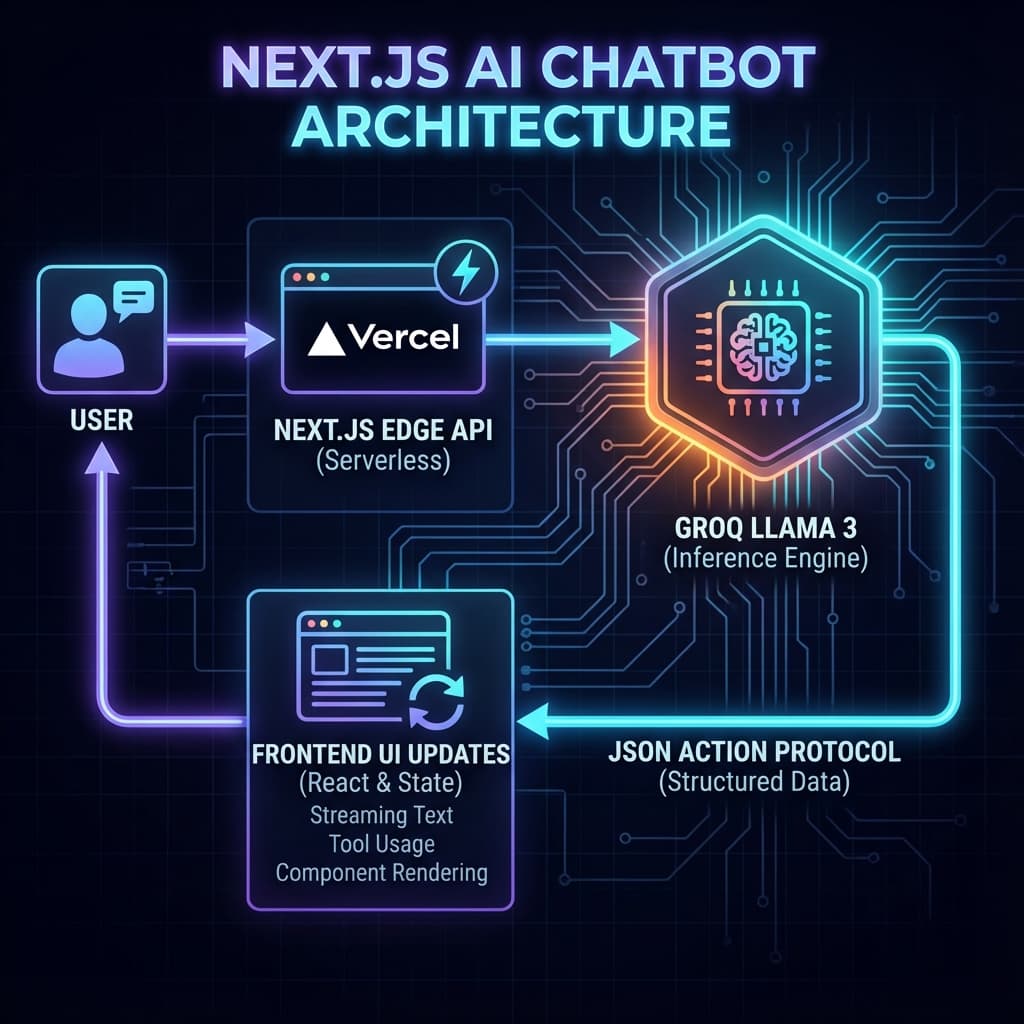
1. API Proxying (Edge Layer): Groq/OpenAI API keys never touch the client's browser. All requests pass through an intermediate server (Next.js Edge Runtime) that securely injects credentials.
2. Data Privacy: The current implementation follows a 'Stateless Conversation' policy. We do not store persistent logs of user conversations in a database, ensuring that sensitive questions about strategy or business are not permanently recorded.
3. Input Sanitization: Protection against 'Prompt Injection' via strict Zod schema validation before processing any action command.
Technical Demo: Action Protocol
What makes this solution unique is its ability to 'touch' the interface. Unlike a standard chatbot that only returns text, this agent emits Structured Intents (JSON). The frontend listens for these intents and executes state changes (Navigation, Highlighting, Scroll).
Economic Viability & Scalability
Cost is decisive. Implementing GPT-4 for a public customer service can be ruinous. This architecture uses Llama 3 on Groq, reducing inference costs by 95% compared to massive proprietary models, without sacrificing intelligence for navigation tasks.
Latency: <300ms (Time-to-First-Token). Real-time feel.
Scalability: Being Serverless, the infrastructure scales to zero when not in use (0€ cost) and can absorb traffic spikes from thousands of concurrent users without additional configuration.
Enterprise Applicability
This same architecture is directly translatable to internal Fortune 500 use cases:
Employee Onboarding: A bot that not only explains how to request vacation but opens the HR form for you.
Technical Documentation Search: RAG (Retrieval Augmented Generation) connected to Confluence/Jira to answer engineering questions with citations to private documents.
• Smart Dashboards: "Show me Q3 sales" -> The bot navigates and filters the Tableau/PowerBI dashboard automatically.
It is a modular, secure, and model-agnostic solution (plug-and-play with Azure OpenAI or Bedrock).
System Architecture
Decoupled design for maximum maintainability:
Voice AI: Dual Engine System
The assistant features a sophisticated Text-to-Speech system with two engines:
1. Browser Voice (Free): Uses the native Web Speech API. Zero cost, works offline, but quality varies by device.
2. Google Cloud TTS (PRO): Neural2 voices with natural intonation. Professional-grade audio that sounds like a real person.
Users start with Browser voice and can upgrade to Google Cloud with one click. This showcases a freemium upsell pattern commonly used in SaaS products.
Automatic Language Detection
The voice system includes real-time language detection that analyzes the response content and selects the appropriate voice:
English responses → `en-US-Neural2-D` (American male)
Spanish responses → `es-ES-Neural2-F` (Spanish female)
* German responses → `de-DE-Neural2-D` (German male)
This happens automatically with zero configuration from the user, creating a seamless multilingual experience.
Interactive Navigation + Voice
When voice is enabled, the assistant narrates while navigating. As it explains my experience at Gigas, it scrolls to that section. When it mentions ESADE, it switches tabs and expands the education card.
Timing is carefully calibrated: navigation happens before the voice mentions the topic, creating a synchronized tour experience that feels like having a personal guide.